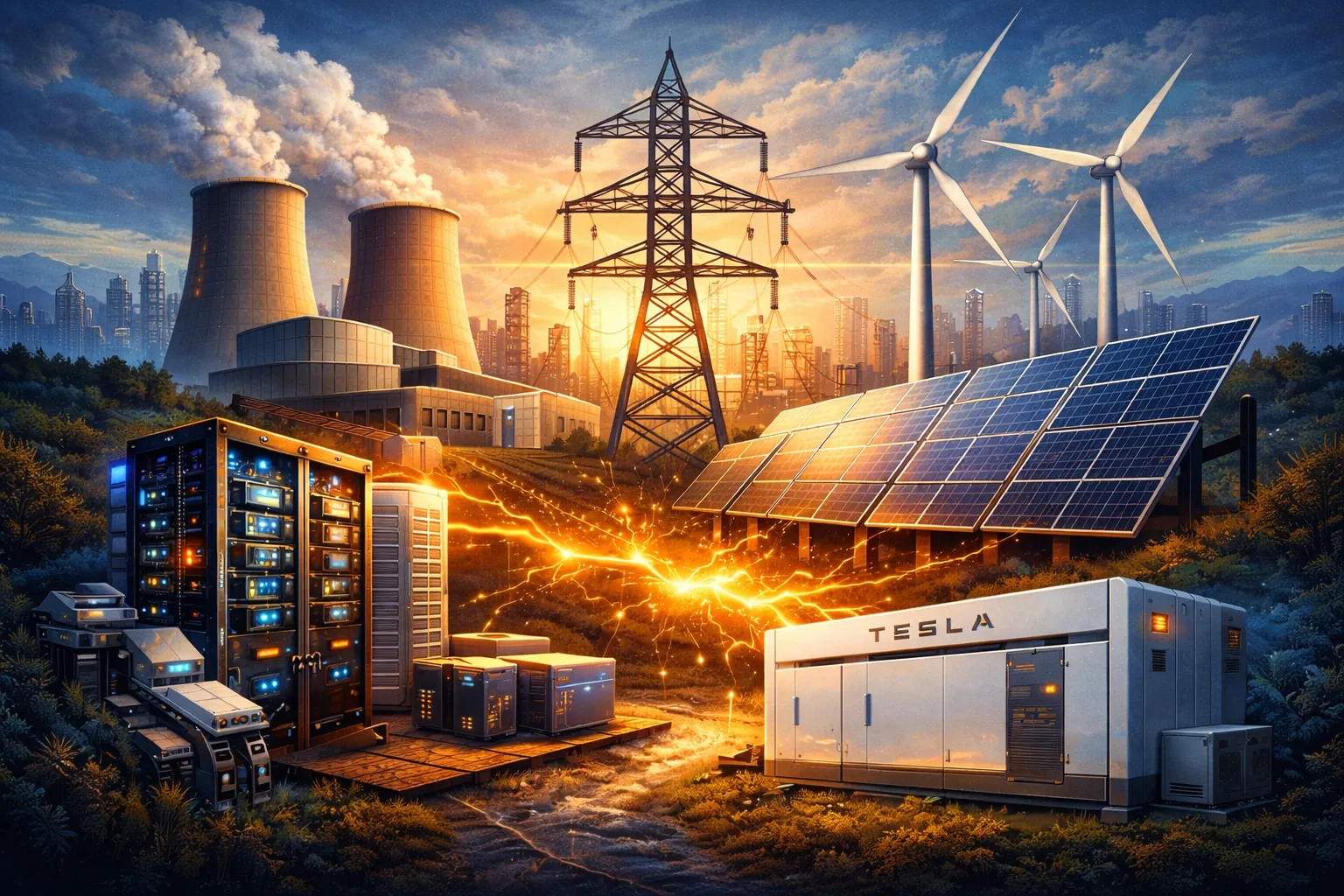

Most investors still treat AI as a chip-and-model story. That is now incomplete.
In the first phase (2023-2025), value concentrated in compute scarcity. In the next phase (2026-2032), the constraint shifts to electricity, transmission, cooling, and uptime. If power cannot scale, AI revenue cannot scale.
This is why the next durable winners may not be the companies building frontier models, but the companies selling electrons, transformers, thermal management, and reliability.
What Changed: The Data Behind the Power Thesis
Several hard signals now support the electricity-supercycle view:
- IEA (April 10, 2025): global data-center power demand is projected to more than double by 2030, to ~945 TWh, with AI as the main incremental driver.
- EIA (January 13, 2026): U.S. power demand is forecast to post its strongest four-year growth streak since 2000, with large computing facilities as a key driver.
- Deloitte (October 29, 2025): U.S. peak demand is projected to rise ~26% by 2035, with data-center load potentially reaching 176 GW.
- Berkeley Lab queue data (2024-2025 editions): interconnection backlogs remain a structural bottleneck, forcing more creative power sourcing.
Translation: AI demand can grow faster than grid capacity. When that happens, value shifts to the companies that remove bottlenecks first.
The AI Power Stack (How to Analyze the Trade)
The cleanest way to avoid hype is to follow where projects fail in the real world. AI does not stall because of ideas. It stalls when physical systems cannot support deployment speed.
AI Models
↓
Data Centers
↓
Power Density + Cooling Intensity
↓
Grid Interconnection + Transmission
↓
Generation + Storage + Power Management
Most portfolios over-index the top of this stack (models and chips). The edge is lower, where constraints are physical, regulated, and measured in years instead of quarters.
Categories (Clickable)
Use this as a full research universe. The top-10 list below is selected from this broader set.
⚡ Utilities Powering AI
Role: converts AI load growth into regulated rate-base expansion and long-cycle power contracts.
🔌 Grid & Electrification
Role: the picks-and-shovels layer: electrical gear, cooling, controls, and transmission buildout.
🔋 Storage & Distributed Energy
Role: resilience and flexibility where grid timelines are too slow for AI deployment schedules.
☢️ Nuclear & Baseload
Role: firm 24/7 power and fuel-chain optionality for long-duration AI electricity demand.
How We Chose the Top 10 (From the Full Category Universe)
Selection here prioritizes: direct AI demand linkage, backlog visibility, ability to monetize bottlenecks, and balance-sheet resilience.
Top 10 AI Power Infrastructure Stocks (Highest Conviction)
| Ticker | Layer | Why It Matters | Key Risk |
|---|---|---|---|
| NEE | Utilities | Scale in renewables, transmission, and long-cycle project execution. | Execution + policy sensitivity. |
| CEG | Nuclear Baseload | Scarce 24/7 carbon-free generation; direct hyperscaler relevance. | Policy, outage, and relicensing risk. |
| DUK | Regulated Utilities | Data-center corridor exposure with regulated return framework. | Rate-case friction. |
| SO | Regulated Utilities | Grid modernization plus baseload relevance in Southeast growth markets. | Project cost overrun risk. |
| ETN | Power Management | Electrical gear and quality systems are mandatory in every AI build. | Valuation compression if orders normalize. |
| VRT | Thermal + Power | High-density cooling and power delivery directly tied to GPU cluster expansion. | Capex digestion cycles. |
| PWR | Transmission Buildout | Transmission and interconnect work converts demand into realizable load. | Permitting and labor constraints. |
| D | Regulated Utilities | Data-center demand exposure with regulated capex and grid modernization tailwinds. | Rate-case and execution risk. |
| TSLA | Grid Storage | Megapack scales into utility and site-level resiliency demand. | Execution volatility across segments. |
| FLNC | Storage Specialist | Purer battery-system leverage to grid instability and peak shaving demand. | Project timing and margin volatility. |
Extended Watchlist (Second-Tier but Important)
These names were part of the original framework and remain relevant even outside the core list:
- D, CNP: utility names with high data-center load exposure and capex expansion narratives.
- NVT: power/thermal management adjacency for data-center infrastructure.
- BE, GNRC, ENPH: distributed and behind-the-meter resilience pathways.
- CCJ, BWXT: nuclear fuel and advanced reactor supply-chain leverage.
- WMB, KMI: gas infrastructure as bridge-fuel support for near-term power deficits.
- GLW: fiber layer beneficiary from AI data-center networking expansion.
AI Energy Supercycle Timeline (2024-2035)
- 2024-2025: compute scarcity dominates; GPU and cloud capex lead market leadership.
- 2026-2028: interconnection and cooling constraints become visible; utilities and electrical equipment rerate.
- 2028-2031: transmission and firm-power contracts become decisive; storage and baseload gain pricing power.
- 2031-2035: grid modernization and reliability architecture determine durable winners versus commoditized suppliers.
The practical implication: this is not a single trade. It is a rolling sequence of bottlenecks.
Educational Moat: The Four Explainers Most Investors Skip
1) Why AI Needs Nuclear Power
AI inference and training loads run continuously, while wind/solar output is variable. Nuclear is one of the few scalable, low-carbon baseload sources that can support 24/7 demand profiles without relying entirely on storage overbuild.
2) Why Transformers Are Functionally Sold Out
Transformer lead times expanded because the entire system is ordering at once: utility upgrades, industrial electrification, and hyperscale campuses. Transformer capacity is not software-like; it scales through physical manufacturing footprint, labor, and long procurement cycles.
3) Why Data Centers Build Private Power Plants
Interconnection queues and transmission delays are long enough that many projects cannot wait for grid timing. Behind-the-meter generation, microgrids, and on-site backup are increasingly used to secure uptime and reduce go-live risk.
4) Electricity Bottleneck vs Compute Bottleneck
Compute bottlenecks are improved by better chips and software efficiency. Electricity bottlenecks require permits, substations, transformers, transmission lines, and generation assets. One improves on software/hardware release cycles; the other moves on infrastructure timelines measured in years.
Where the Edge Is: A Better Way to Rank Names
Instead of asking "what AI stock should I buy?", score each candidate on four dimensions:
- Bottleneck ownership: does the company control a hard constraint?
- Pricing power: can it pass through inflation and keep margins?
- Time-to-revenue: how quickly do new orders convert to cash flow?
- Policy/regulatory dependency: how much depends on approvals?
In this cycle, bottleneck ownership and time-to-revenue matter more than narrative quality.
Catalysts to Watch in 2026-2028
- Hyperscaler PPAs: long-term power contracts with utility, nuclear, and storage providers.
- Interconnection outcomes: queue conversion rates and transmission approvals.
- Cooling transition: air-to-liquid retrofit pace in hyperscale facilities.
- Load migration: growth outside Northern Virginia into Texas, Midwest, and Southeast hubs.
- On-site generation: increased microgrid and behind-the-meter deployments where grid lead times are too long.
What Could Break the Thesis
- AI capex pause: hyperscalers slow buildouts faster than expected.
- Efficiency shock: major gains in model or hardware efficiency reduce power intensity.
- Policy whiplash: unfavorable rate-case, permitting, or subsidy shifts.
- Overbuild + compression: capacity catches up, then pricing power fades.
Strong theme, but entry price still matters. Many names in this basket have already re-rated.
Portfolio Construction (Research Template, Not Advice)
A practical structure for further research:
- 30-35%: regulated utilities and baseload providers (stability)
- 30-40%: grid and thermal equipment (operating leverage)
- 15-20%: storage and distributed power (convex upside)
- 10-15%: nuclear fuel/supply chain and selective spec positions
The objective is simple: own the parts of the system that get paid first when demand tightens.
Run the Analysis Per Ticker
- AI Stock Analysis Hub - compare names across the power stack.
- AI Energy Infrastructure Category - browse the full category page with stack-map workflow.
- VRT AI Analysis - cooling and power delivery.
- ETN AI Analysis - electrical system bottleneck exposure.
- CEG AI Analysis - baseload and nuclear contract thesis.
- NEE AI Analysis - utility scale and transmission growth.
The key shift is no longer theoretical: AI demand growth is colliding with physical energy constraints. The winning research process starts there.